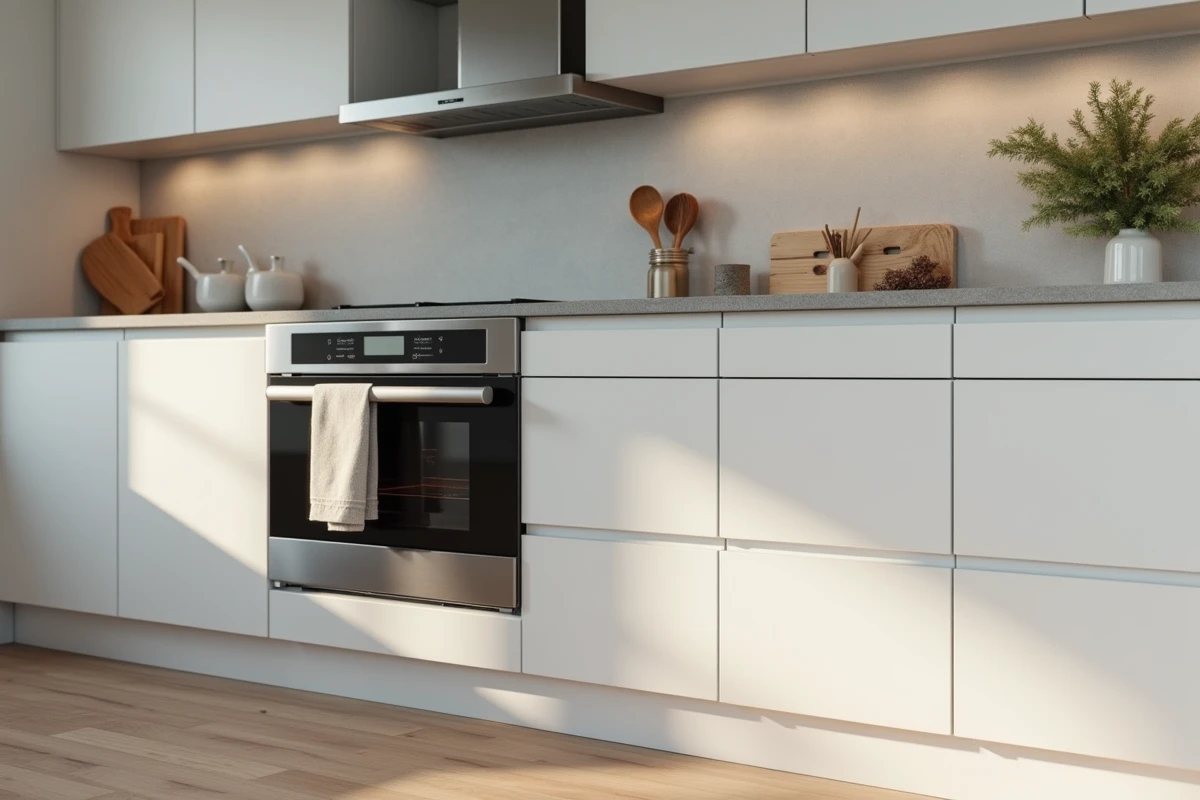
Placing an oven and a dishwasher side by side or one above the other in a kitchen raises a specific technical question: what distance should be maintained to avoid heat transfer and malfunctions? The answer depends less on a universal standard than on the installation manuals for each appliance, and this is where most layout errors occur.
Thermal Loads and Ventilation: What the NF C 15-100 Standard Really Covers
The NF C 15-100 standard, in its amendments adopted by the industry in 2024-2025, strengthens the requirements regarding the ventilation of built-in appliances. It prohibits placing an oven directly under a cooking point but does not set a universal distance between an oven and a dishwasher.
The real regulatory issue concerns the thermal dissipation around the oven. A built-in oven generates residual heat that must be dissipated through grilles or free spaces defined by the manufacturer. If a dishwasher is located in the dissipation zone, its electronic components and seals may degrade prematurely.
When planning the spacing between the dishwasher and the oven, the first step is to consult the oven manual: it specifies the minimum distances to be maintained on each side (back, lateral, underneath). These values vary from one model to another, sometimes by a factor of two.

Distance Between Oven and Dishwasher: Table of Common Configurations
Rather than a single distance, kitchen configurations determine the level of thermal risk. The table below summarizes the most common scenarios and the appropriate solution for each.
| Configuration | Thermal Risk | Recommended Solution |
|---|---|---|
| Oven and dishwasher side by side, same countertop | Moderate | Filler cabinet (min. one storage unit between the two) |
| Oven in column, dishwasher below | High | Insulating panel in between and clear rear ventilation |
| Oven in column, dishwasher at a distance (other wall or other side) | Low | No specific precautions beyond the manual |
| Oven under counter, adjacent dishwasher without separation | High | Insert a thermal panel or offset by one unit |
The most problematic configuration remains the oven in column with the dishwasher positioned directly below. This arrangement, proposed by some kitchen designers to save space, concentrates heat in a confined area. Feedback from installers published in 2024-2025 confirms that the intercalated insulating panel is the preferred solution.
Insulating Panel or Separator Cabinet: Selection Criteria for Your Kitchen Plan
The trend observed among professional installers is towards physical separation between the two appliances rather than just empty space. Two options dominate.
The Filler Cabinet
A standard storage unit placed between the oven and the dishwasher absorbs some of the heat and creates a natural barrier. This solution works well in L-shaped or U-shaped kitchens where the layout provides enough linear space.
- The unit must be ventilated at the back to avoid trapping heat, especially if the oven is a convection model
- A cutlery drawer or spice storage serves this function without losing useful space
- Ensure that the material of the unit can withstand prolonged exposure to heat (high-resistance melamine or solid wood)
The Thermal Insulating Panel
In small kitchens where every centimeter counts, the thin insulating panel is fixed against the side wall of the oven. It reduces heat transfer to the neighboring appliance without consuming floor space. Hardware stores offer panels suitable for built-in installation, with reduced thickness.
The choice between the two depends on the available space. Below three linear meters of base cabinets, the insulating panel is often the only realistic option. Beyond that, the separator cabinet provides both insulation and storage.
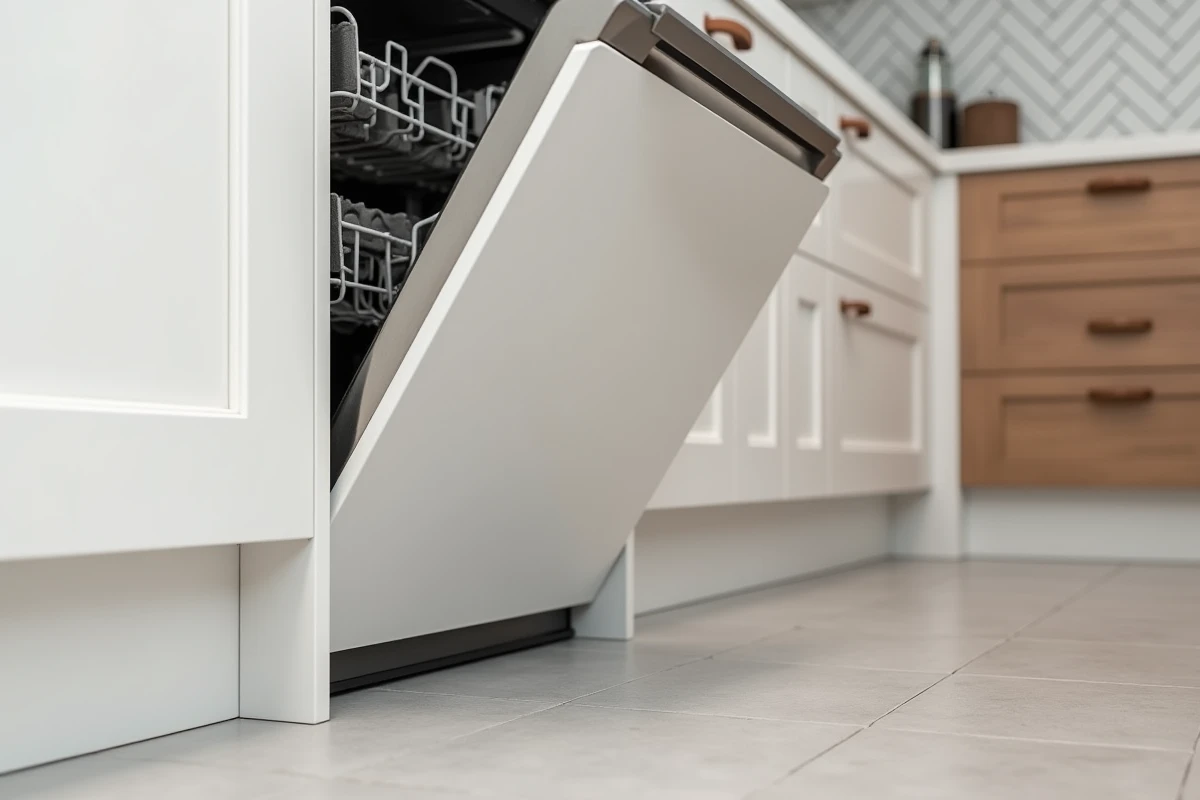
Manufacturer’s Manual and Activity Triangle: Two Constraints to Consider
Manufacturers like Bosch and Siemens increasingly emphasize, in their updated support content for 2025, the importance of following installation manuals rather than adhering to a standard distance. Each appliance has its own clearance requirements.
This technical constraint overlaps with that of the kitchen activity triangle, which connects the three functional areas: cooking, washing, and storage. A layout that respects thermal distance but places the dishwasher opposite the sink creates an ergonomic problem in daily use.
- The dishwasher benefits from being adjacent to the sink to shorten water circuits and facilitate loading
- The oven should preferably be positioned away from the wet area (sink, dishwasher) to limit condensation on its surfaces
- In a linear kitchen, the sequence sink, dishwasher, separator cabinet, oven remains the layout that balances ergonomics and thermal safety
Cross-referencing these two perspectives (manufacturer’s manual and kitchen layout ergonomics) allows for a solid compromise. A layout that satisfies one but ignores the other will eventually lead to problems, either in maintenance or daily use.
The key point to remember: no universal distance replaces reading your oven’s manual. It specifies the exact lateral and lower clearances. The rest, whether it’s a separator cabinet, insulating panel, or simple spacing, follows from that. A well-designed kitchen starts with this document, not with a generic rule found online.