
A newborn requires a limited amount of equipment, provided that each item is selected based on specific technical criteria. We regularly observe baby registries overloaded with accessories that won’t be used until the fourth month, while critical items like sleeping arrangements or car seats are chosen without checking current standards. Here are the points we recommend prioritizing to equip a baby from birth.
R129 Standard and Car Seat: The First Essential for Baby to Check Before Purchase
As of September 1, 2024, car seats approved under the old R44/04 standard can no longer be sold new in the European Union. Only models compliant with the R129 (i-Size) standard are allowed for sale.
This regulation changes the game for parents preparing their baby registry. The R129 standard mandates rear-facing travel until at least 15 months, with specific height thresholds before transitioning to forward-facing. Always check for the R129 mention on the approval label, especially when making an online purchase or buying from clearance sales.
A second-hand seat approved under R44/04 remains legal for use, but its level of protection in the event of a side impact is significantly lower than that of an i-Size model. We recommend considering the car seat as the priority item in the budget, even before the crib or stroller.
Specialized retailers allow you to test the compatibility of the car seat with your vehicle, which is difficult to assess from a catalog. The range learn more about Lol Baby covers transportation and childcare equipment that meets current standards.
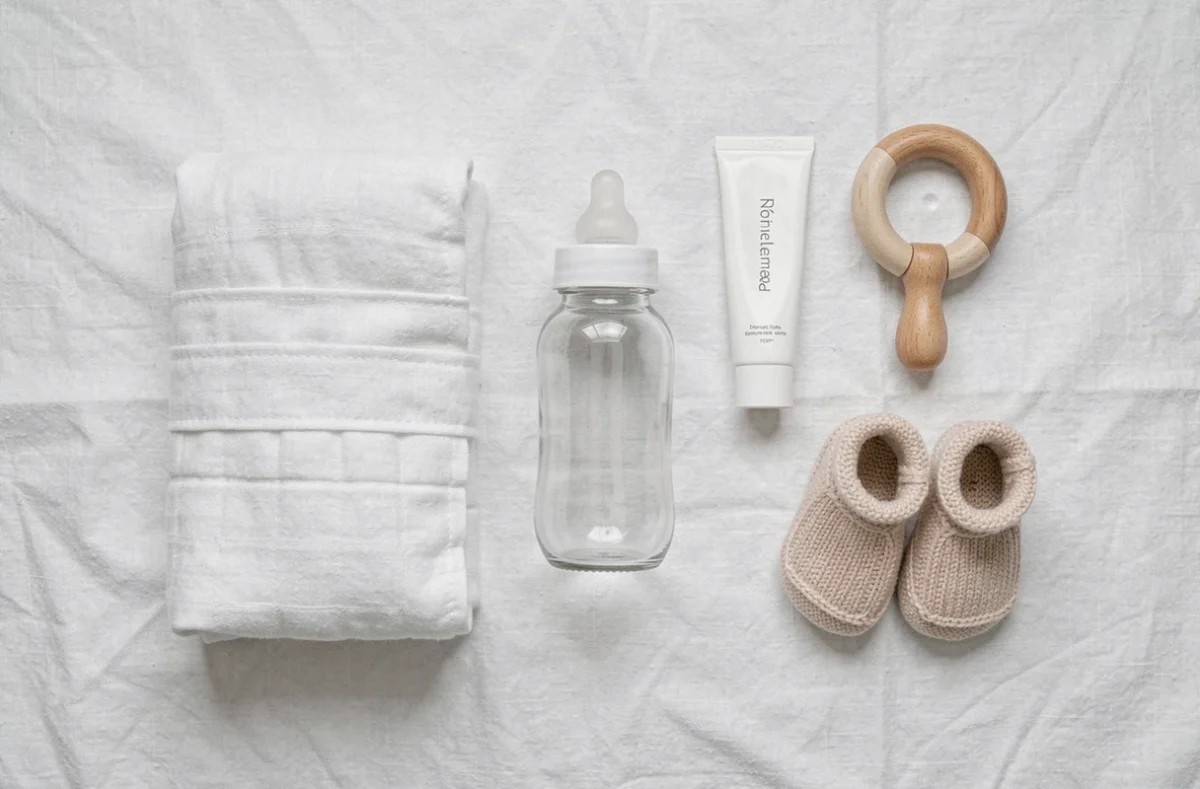
Newborn Sleeping Arrangements: Firm Mattress, Sized Crib, and Nothing Else
Sleeping arrangements are the second area where technical errors are common. A firm mattress that perfectly fits the dimensions of the crib is the foundation of nighttime safety. No gaps should remain between the mattress and the sides of the crib.
The sleeping bag replaces blankets and comforters. We recommend having two sleeping bags suitable for the season to allow for washing rotation. The choice of TOG (thermal insulation) depends on the room temperature, ideally maintained around 18 to 20 °C.
What Should Not Be in the Crib
Bumper pads, pillows, positioning cushions, stuffed animals: none of these items should be in a newborn’s crib. Pediatric recommendations are clear about a bare sleeping space. A standard crib with a compliant mattress is sufficient for the first months. A co-sleeping cradle remains an option if the frame is rigid and the mattress is dedicated, but it will be abandoned as soon as the child starts to roll over.
GPSR Regulation and Safety of Childcare Equipment
The Regulation (EU) 2023/988 on the general safety of products has been fully applicable since December 13, 2024. It replaces the old directive and directly concerns the essentials for baby: bottles, pacifiers, bouncers, high chairs, and strollers.
In practice, each product must now display enhanced traceability information and an accessible reporting channel for consumers. This point deserves attention when purchasing on marketplace platforms where compliance of third-party sellers is more difficult to verify.
For parents buying second-hand, the risk lies with products that predate the regulation and do not have these markings. We recommend checking for the CE marking and looking for the batch number on the Safety Gate database of the European Commission before any second-hand purchase.
Feeding from Birth: Breastfeeding or Bottle, Two Distinct Sets
The choice of feeding method dictates half of the baby registry. The two configurations do not require the same equipment, and the items are not interchangeable.
Breastfeeding Configuration
- Breastfeeding bras (plan for at least three for rotation), washable or disposable pads, and a lanolin-based cream for the first weeks
- Manual or electric breast pump, with the option to rent a hospital model at the pharmacy to test before investing
- One or two bottles compatible with breast milk for occasional feeding, checking the nipple flow (slow flow for a newborn)
Bottle Feeding Configuration
- Six small capacity bottles with flow 1 nipples, a dedicated bottle brush, and a drying rack are sufficient for the first weeks
- A bottle warmer is not mandatory: a water bath works, but a bottle warmer saves time during nighttime awakenings
- Systematic sterilization is no longer recommended by most health professionals if cleaning is thorough, but a sterilizer remains useful in case of non-potable water or travel
Diapering and Hygiene: Consumables Matter More Than the Furniture
The changing table is a comfort, not a necessity. A changing mat placed on a stable and appropriately high piece of furniture serves the same function. What really matters is the stock of consumables.
Planning for a sufficient quantity of diapers for the first week avoids emergency shopping. A newborn uses a significant volume of diapers each day. Water wipes or oleo-calcareous liniment with cotton squares remain the most suitable solutions for infant skin.
Individual doses of saline solution serve for both the nose and eyes. We recommend stocking a box before birth. A bath thermometer and a body thermometer complete the care kit, along with a nasal aspirator and sterile compresses.
Newborn Clothing: Think in Terms of Washing Rotation
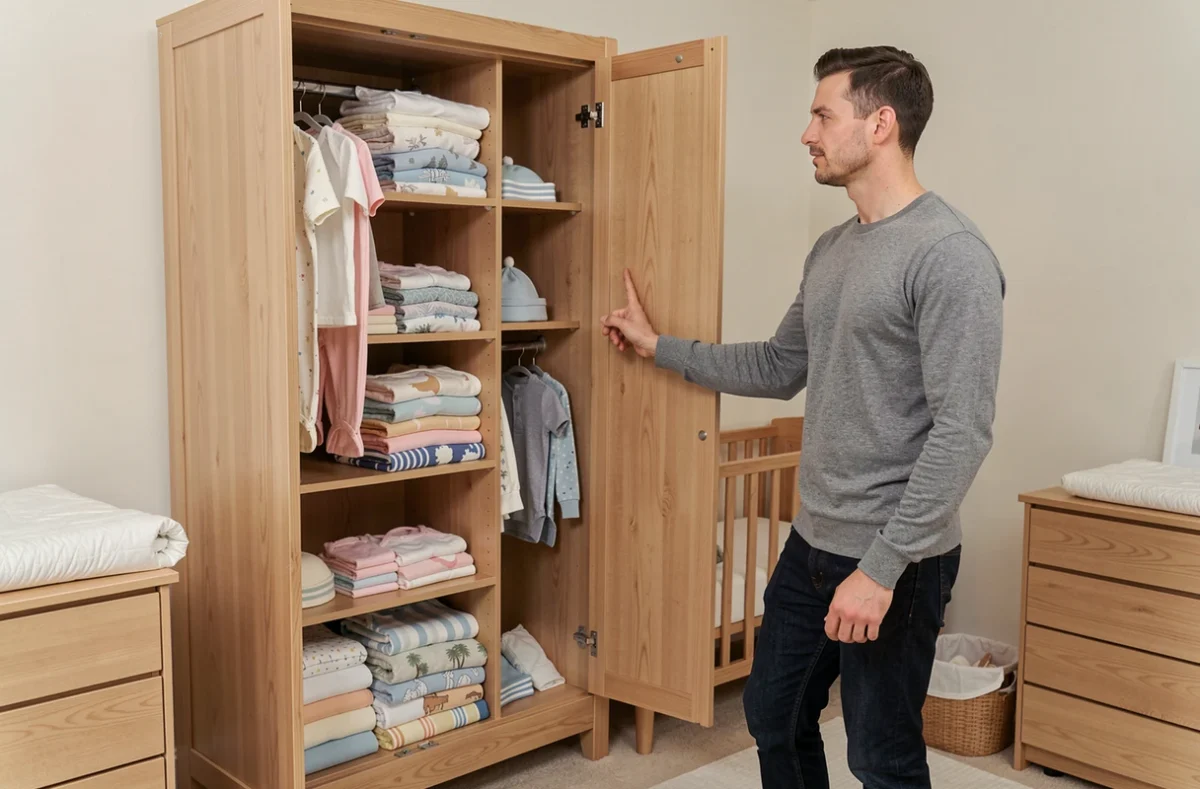
The temptation to accumulate newborn-sized clothing is strong. In practice, five to seven bodysuits and as many pajamas cover a three-day rotation between two washes. Sizes vary by brand, and a standard-sized baby will quickly move to the next size.
Opt for crossover bodysuits (or “wrap-around”) for the first weeks: they avoid putting the garment over the head, simplifying changes and reducing discomfort. Two hats, two pairs of socks or soft booties, and a knitted cardigan complete the layette without excess.
The list of essentials for baby boils down to equipment that complies with current standards, sized for the first weeks, and selected based on safety criteria before comfort or aesthetics. Each additional item deserves the question: do I need it before the third month? If the answer is no, it can wait.